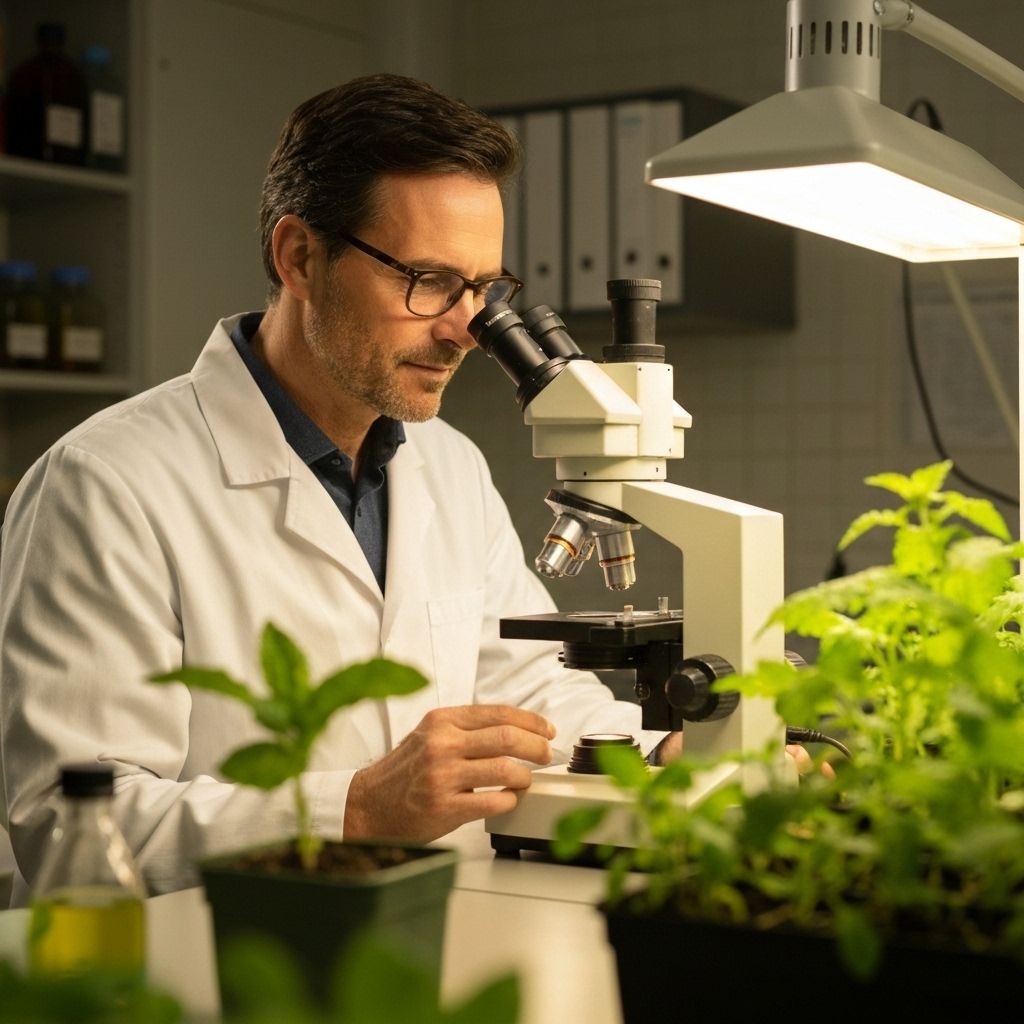
The centrifuge was the first sound I learned to recognize. A low, steady whir, like the heartbeat of the lab. Paired with the faint sting of ethanol in the air and the clutter of glass pipettes on steel tables, it created a rhythm I carried with me for two months.
At first, I thought of it as just noise. But slowly, I realized it was a kind of language. Every hum, every beeping spectrophotometer, every colony blooming on a petri dish was a story—about resilience, survival, and sometimes, failure. And that story didn’t belong only to plants or microbes. It belonged to us.
Learning to See the Invisible
The Animal–Plant Interactions (API) Lab at Sri Venkateswara College is a space where plants, microbes, and insects come together in ways textbooks can’t quite capture. My project began with soil bacteria—tiny, invisible allies. I learned to isolate them, inoculate them into plants, and then measure the changes: proteins rising, sugars shifting, enzymes waking up like hidden guardians.
At the bench, it was all about precision. Pipette exactly 100 microliters. Balance centrifuge tubes so they spin without shattering. Record absorbance at 595 nanometers. The work felt delicate, almost ceremonial, as if the smallest slip could break the spell.
But behind the numbers was a bigger revelation: resilience often hides in partnerships we don’t see. A leaf is never just a leaf; it’s a community of microbes, chemicals, and defenses, all whispering to each other. Watching plants respond differently when inoculated with bacteria, I realized that agriculture’s future may lie in these invisible conversations.
And yet, policy rarely listens to them. Governments still subsidize chemical fertilizers, while microbial inoculants—cheap, sustainable, effective—barely make it into mainstream programs. In the lab, I could see resilience under the microscope. In the world outside, it was being overlooked.
The Messy Beauty of Failure
Not everything worked. DNA pellets sometimes refused to form. Colonies vanished overnight. Spectrophotometer readings looked suspiciously wrong. At first, failure felt like a personal defeat. But slowly, I began to see it differently.
Every error carried a clue. Increase centrifuge speed. Adjust incubation temperature. Clean glassware more carefully. Each mistake was a conversation with the experiment—a negotiation.
And isn’t policy like that too? A rainwater harvesting system succeeds in one Delhi neighborhood but collapses in another. A groundwater law looks good on paper but fails in practice. Like science, governance is iterative. You try, you fail, you adjust. What matters is not the perfection of the outcome but the willingness to learn from what didn’t work.
That was perhaps the most surprising thing the lab taught me: that failure is not waste, it’s wisdom. A lesson the policy world desperately needs.
Molecules with Mandates
By the end of July, I could rattle off lab procedures with ease—Bradford assay for protein, Gram staining for bacterial morphology, qPCR for gene expression. But when I stepped back, I began to see them differently. They weren’t just protocols. They were arguments.
Every sugar assay hinted at food security. Every DNA band on a gel hinted at ecological resilience. Every insect behavior test hinted at the fragility of urban ecosystems.
It was as if the lab bench stretched outward, touching fields, farms, and forests. What happened in a centrifuge tube was linked, invisibly but powerfully, to what happened in policy documents, parliamentary debates, and city plans.
And I kept asking myself: why aren’t these connections clearer in the world outside the lab? Why does evidence so often stall before it reaches decision-makers? Why is it easier to fund a fertilizer subsidy than a microbial inoculant program?
Carrying the Lab Outside
On my last day, I walked out of the lab carrying more than my notebook. I carried the rhythm of the centrifuge, the carefulness of pipetting, the patience of waiting for colonies to grow. But more than that, I carried conviction.
That the smallest things—the microbe on a root, the decimal on a spectrophotometer—deserve space in the biggest rooms. That science must travel, not as jargon-heavy reports but as stories people can feel. That policy needs evidence, yes, but also empathy—the ability to see that a plant struggling under insect attack is not so different from a farmer struggling under debt.
The lab taught me to measure carefully. But it also taught me to imagine widely. To see how a protocol in Delhi could ripple into a policy in India, and maybe even into global conversations about sustainable agriculture and climate resilience.
From Roots to Horizons
Sometimes, late at night, I would look at the blue bands glowing on an agarose gel and wonder: what do they mean beyond this room? A band of DNA doesn’t feed a family. A protein concentration doesn’t restore a wetland.
And yet, in another sense, they do. They are fragments of a bigger picture—pieces of resilience waiting to be assembled into policy, practice, and culture.
That’s what my internship showed me: that science is not just for discovery, it’s for translation. For turning assays into arguments, microbes into mandates, failures into frameworks.
The centrifuge’s hum may sound far from the policymaker’s desk, but they are part of the same continuum. And my journey, from bench to horizon, is about carrying those invisible threads forward—so that the quiet work of microbes, plants, and students doesn’t stay hidden, but shapes the way we imagine resilience itself.
— Sneha 🌿