Sometimes, the most urgent problems don’t announce themselves.
They trickle. They seep. They vanish underground.
That’s how it began—with a question that didn’t make the news:
Where is Delhi’s water really going?
Not the water in pipes or puddles.
But the water deep beneath our feet. The kind that takes centuries to form. The kind that holds up a city in ways we never fully see—until it begins to disappear.
🌍 The Silent Collapse Beneath the City
Delhi, like many megacities in the Global South, runs on groundwater.
It hums quietly beneath the chaos—supplying over 50% of the city's water demand during peak scarcity seasons. But this safety net is fraying fast.
From 2013 to 2023, I found that groundwater levels in key districts like South and South-West Delhi declined by up to 20 meters— —from just beneath the soil to depths that now demand industrial-scale extraction methods.
What had once been accessible with a simple hand pump now required borewells, permissions, and power.
But the most startling part wasn’t just how much water was lost.
It was how quietly it happened.
No breaking news. No crisis headlines.
Just an invisible descent—year by year, meter by meter—beneath a city too busy to notice.
📊 What the Data Revealed
As part of my research, I studied 10 years of groundwater level data sourced from the Central Ground Water Board (CGWB) and Delhi Jal Board (DJB), tracking district-wise fluctuations.
I paired this with rainfall data from the India Meteorological Department (IMD), GIS visualizations, and chemical contamination patterns mapped across Delhi’s seven major districts.
Here’s what emerged:
Groundwater depletion was most severe in South, South-West, and New Delhi, where levels plunged by more than 2 meters annually in some years.
Rainfall variability, with multiple years of below-normal monsoon, compounded the crisis. Even when rain returned in 2021, recharge rates lagged.
In districts like North-West and West Delhi, I observed increasing fluoride and nitrate contamination, a red flag for both public health and aquifer stress.
This wasn’t just a water scarcity issue. It was an urban systems failure—a silent, systemic crisis shaped by poor planning, over-reliance on extraction, and regulatory inattention.
🏙️ The Urban Paradox: Growth vs Recharge
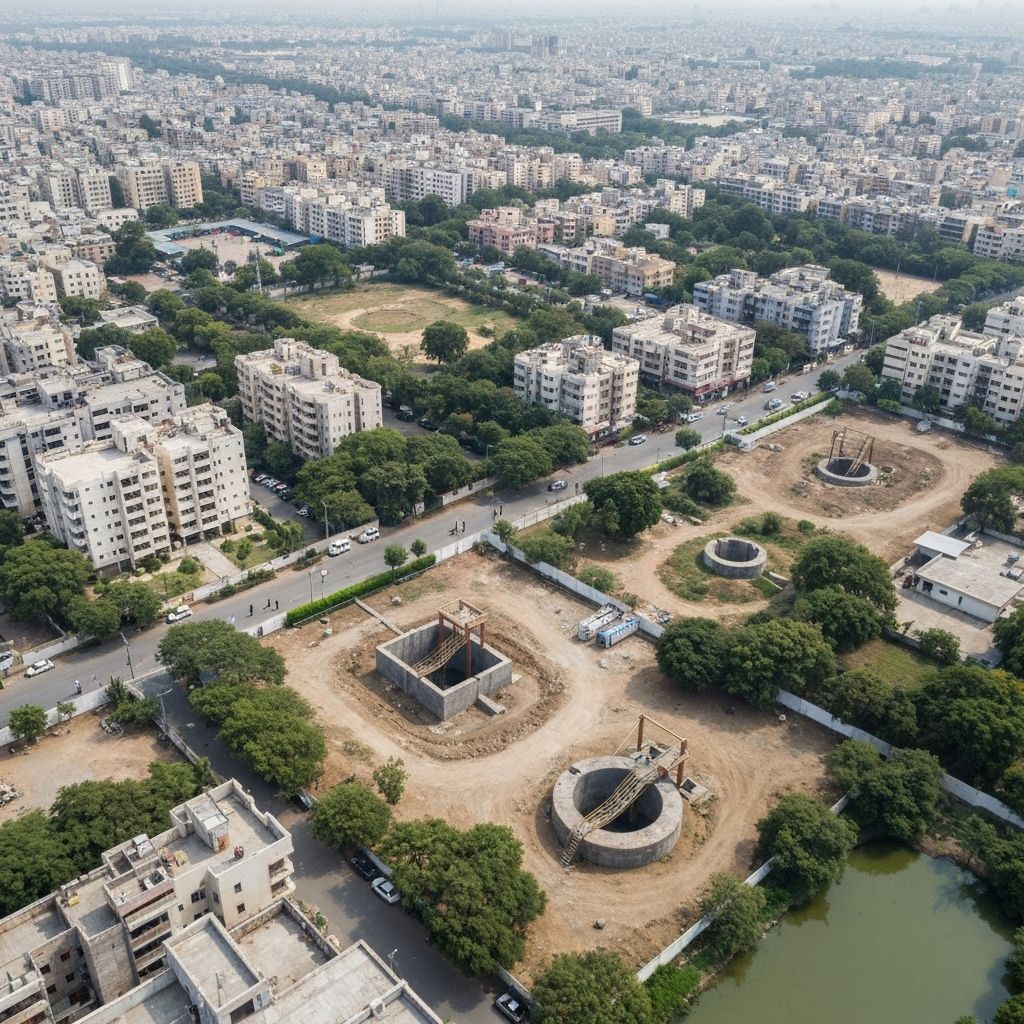
What struck me most was how directly urbanization was linked to water loss.
Over the past 50 years, Delhi has grown upward, outward—and downward.
Farmlands became high-rises. Open ground was paved over.
And the surfaces that once soaked in rain now bounced it away into storm drains.
Recharge areas shrank as the city expanded.
It’s a classic example of what the ECM course at Oxford calls a “coupled human-environment system.” The groundwater crisis wasn’t just environmental—it was structural, political, and deeply social.
🧠 From Research to Reflection: What I Learned
This project made me see cities differently.
Before, I saw Delhi’s water crisis as a resource problem.
Now, I see it as a systems problem—an intersection of geology, policy, equity, and everyday behavior.
It raised deeper questions:
Who gets access when water becomes scarce?
What role should decentralized governance play in groundwater monitoring?
Can we design urban spaces that absorb and restore instead of just extract and expand?
These are the same questions I hope to explore further in graduate study—especially in programs like ECM that prioritize integrated, solutions-oriented, and equity-focused thinking.
🌱 Reimagining Water in the City
We need more than data.
We need imagination.
In my research recommendations, I proposed:
Scaling up urban rainwater harvesting, modeled after successful systems in IIT and JNU campuses.
Community-led groundwater monitoring, using low-cost sensors and open data dashboards.
Greywater recycling incentives for dense housing clusters, where groundwater draw is most intense.
But beyond policy and planning, we need a cultural shift—a new relationship with the ground beneath us.
Because groundwater isn’t just a utility.
It’s a living memory of our city’s past.
And perhaps, if we listen closely, a guide to its future.
✨ A Quiet Crisis Worth Noticing
Not every environmental issue is visible.
Some don’t come with dramatic floods or breaking dams.
Some just drip away, silently carving vulnerability into the foundations of our homes, our futures.
Delhi’s groundwater crisis is one of those.
And writing this post—translating datasets into a human story—reminded me why I chose this path in the first place.
Because policy needs emotion.
Science needs stories.
And cities—like people—need to be understood not just from above, but from below.
— Sneha 🌾